
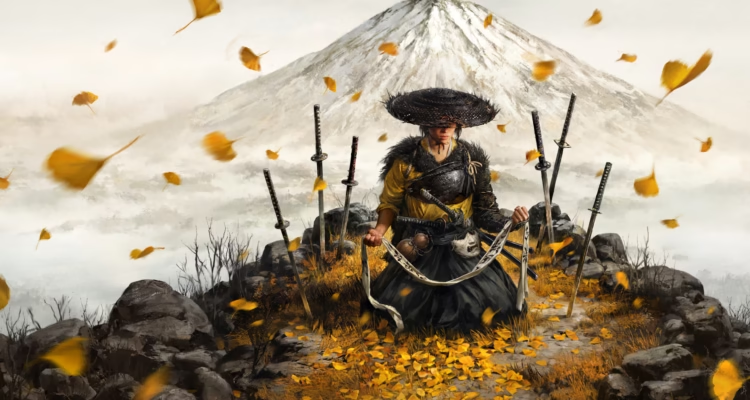
Six Samurai
How do you even begin to craft a sequel to one of the smash-hit titles of a generation? Ghost of Tsushima delivered such a concrete vision of samurai carnage that really pushed the hardware it was made for. So where can you go from there? While it initially seemed that Ghost of Yōtei aimed for a fresh slate, entirely with a new protagonist, setting, and even time period, the truth is unfortunately a bit less ambitious.
After a malevolent masked group of malcontents butcher her family and leave her for dead, Atsu grows up to become a warrior in several conflicts around Japan. We join her as she returns to Ezo, looking to find and slaughter the Yōtei Six who ruined her life. There’s little wrong with this story per se, but it is a rather generic set-up for both a samurai tale and as a video game. This wouldn’t be an issue, but as the story’s pacing leadenly forces players to relive the not terribly interesting circumstances of this revenge plot, it results in a rather dull beginning to the game.
Lady Snowblood
Even the tech showcase of pressing a single button to flip between past and present, to relive child Atsu’s key childhood moments, fails to excite. Inexplicably, some of these serve as tutorials for actions the player has already been performing at that point. The promise of having to play as a version of the character who is restricted in movement and freedom does not excite. Nor do the addition of motion control minigames for cooking, forging metal and setting up campfires. These are just too gimmicky to be immersive. Atsu herself is a fine, functioning protagonist but like Jin Sakai from the original game, is a bit too dry to consider a good hang. Like the original, the main antagonist is far more charismatic and engaging than the lead. This makes any diversions to their side of the story a welcome change of pace.
Samurai Rebellion
While this may sound dreary, once the game opens up, it starts to showcase its true charms. Unlike Tsushima’s more conventional structure, you’re now open to investigate, find and fight the main villains at your leisure. You’ll be given some direction at the beginning, but as you explore and engage with side-content, you’ll hear rumours that will either lead to story progression or new abilities and upgrades. The bounty hunter element of the game is fantastic fun, taking on wonderfully vile rogue ronin around the map. These side activities can stack in a compelling way, too, say a powerful bounty can also be the leader of an enemy camp. The world feels more reactive as a result, some of the freeform joy of recent Zelda’s meeting the reactivity of a Rockstar open-world. It goes without saying that the world looks amazing
Some checklist activities from Tsushima remain. Hot springs, shrines, foxes, but now the world feels designed for you to stumble across these on the way to something else, rather than anything to be targeted. The shrine obstacle courses return, which unfortunately also showcase the lack of interesting new movement mechanics, though at least you have your grapple hook from the get-go now. Your horse is now faster when it goes through white flowers. Historical accuracy aside, the speed increase is welcome, though with the improved hardware and large world, it’s unclear why this isn’t a standard equine velocity.
Sword of Doom
While combat feels largely the same as its predecessor, a few interesting tweaks have been made. The different katana stances have been replaced by different weapons altogether. What this means is a spear-wielding enemy would be better tackled with dual katanas, a big brute dispatched easily with an Ōdachi. You unlock these weapons by training with various masters as you pursue the Six. This means that certain enemy types will be your archenemies until you obtain the right weapon to battle them effectively. Now you can pick up items to hurl at your opponents, such as loose katanas, spears or empty sake bottles. The sheer satisfaction from killing a foe and then using their weapon to impale another is incredible. This adds a true action movie level of entertaining, brutal violence.
Speaking of action films, the oft-mocked but well-intended Kurosawa mode (black and white filter with film grain and dirt) returns. It’s now joined by a Takashi Miike and Shinichirō Watanabe mode. The former ups the level of blood to an absurd degree, and the latter implements some lo-fi hip-hop beats. The Miike one adds a level of stylish carnage that actually adds some much-needed panache to the dry proceedings.
The Last Samurai
Ghost of Yōtei joins its first-part peers this generation (Ragnarok, Forbidden West, Spidey 2 and even On the Beach) as an iterative, not especially innovative sequel to a last-gen gem. Returning ronin looking for a continuation of their Ghost journey will be satiated. However, in a gaming landscape with no shortage of samurai offerings, it’s hard to say that this one stands out. For sheer beauty and exciting duels, this maintains the reputation of the series. If the Ghost series is to continue, however, it’ll need a few more tricks up its sleeve. As far as samurai sequels go, this is no Sanjuro.
Stay tuned to GamEir. Come talk with us on Twitter (@gam_eir), Facebook (@GamEir), and Instagram (@GamEir).